Featured Impact
High-impact systems across catalog, commerce, finance, operations, and automation.
These are representative examples of how I turn business bottlenecks into measurable engineering outcomes across multiple domains, not only finance automation.
Product Quality Platform
Listing Quality Score (LQS)
0.70 -> 0.85 CVR
Improved product quality and customer confidence by giving catalog teams an automatic quality score and A+ to D listing benchmark.
ReactRailsPostgreSQLBackground Jobs
Read Case Study Sales Automation Platform
Event Master
4-5 hrs -> <30 mins
Reduced sale launch delays through early validation, scheduling, retryable processing, audit logs, and automated publishing.
ReactRailsPostgreSQLScheduling
Read Case Study Catalog Automation
Faster Product Go-Live
30 days -> 7 days
Accelerated vendor onboarding and catalog readiness through SKU ingestion, Google Drive media handling, validation, and draft generation.
ReactRailsPostgreSQLGoogle Drive
Read Case Study Finance Automation
Settlers
80% manual effort reduced
Automated settlement workflows across payouts, invoices, GST reports, refunds, and reconciliation while preserving auditability.
ReactRailsPostgreSQLRedis
Read Case Study Projects
Premium case studies across product quality, sales automation, catalog, finance, commerce, and reliability.
Each case study explains the workflow before the system, the pain points, my role, the implementation, and the measurable business outcome.
Listing Quality Score (LQS)
A product quality scoring platform that gave catalog teams a measurable KPI for listing completeness and improved conversion.
Listing Quality Score (LQS)
A product quality scoring platform that gave catalog teams a measurable KPI for listing completeness and improved conversion.
Project visual
Overview
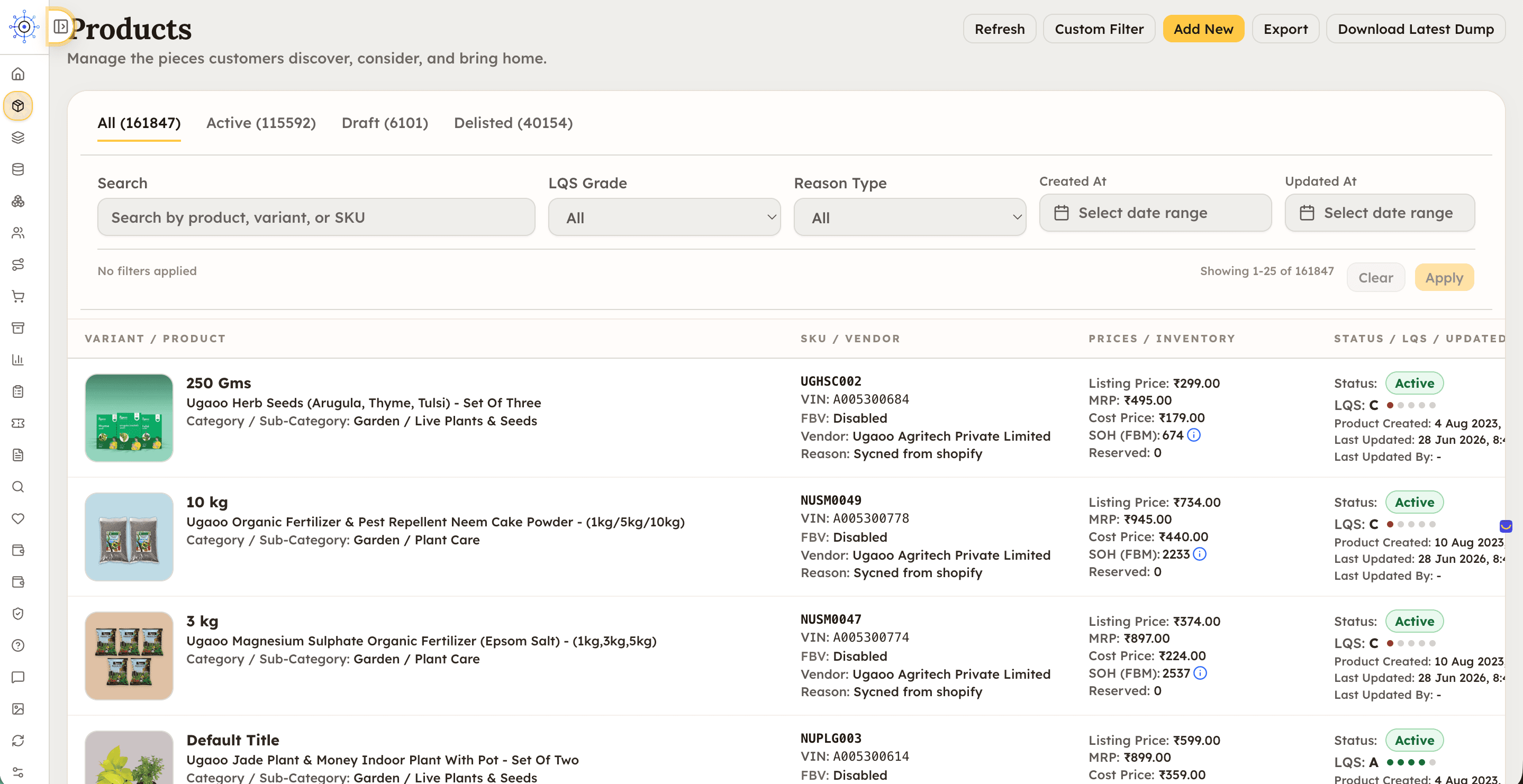
A major reason for poor product conversion was incomplete product information. Customers often reached purchase decisions without enough images, videos, FAQs, feature bullets, descriptions, or upsell context. LQS created a clear product-quality benchmark that catalog teams could use every day.
Executive Summary
Listing Quality Score turned subjective catalog quality into a measurable product-quality system. By automatically scoring every product against images, videos, descriptions, feature bullets, FAQs, and upsell recommendations, the catalog team could prioritize the listings most likely to hurt customer confidence and conversion.
Problem Statement
The catalog team had no measurable way to determine listing quality, so product quality was inconsistent, improvement work was difficult to prioritize, and conversion rate remained lower than expected.
Existing Workflow
Before LQS, catalog improvements were largely manual and judgment-driven. Teams reviewed products reactively, checked missing information by hand, and had no single score that explained whether a listing was ready for high-quality customer discovery.
Business Context
Product listing quality directly influenced customer trust and conversion. A scoring system gave business and catalog teams a repeatable way to improve the listings most likely to affect revenue.
Architecture
Built as a scoring pipeline over product catalog data, where configurable quality parameters evaluate each product and produce a visible rating badge. Scores are persisted for tracking, surfaced in dashboards, and designed to support future parameters without hardcoding every rule.
Solution
Designed and built an automated quality-scoring system where every product receives a rating from A+ to D based on content completeness. The catalog team adopted LQS as a primary KPI and continuously improved product listings until they reached A or A+.
Business Impact
Increased product conversion rate from 0.70 to 0.85 by improving listing completeness, customer confidence, and purchase decision quality.
Pain Points
- Incomplete product information reduced customer confidence before purchase.
- Catalog teams lacked a measurable KPI for listing quality.
- Improvements were hard to prioritize across a large catalog.
- Missing content such as images, videos, FAQs, bullets, and upsells created inconsistent product pages.
Responsibilities
- Designed the scoring algorithm and quality-rating model.
- Built automatic quality evaluation for every product.
- Created a reusable scoring pipeline that could support future scoring parameters.
- Made scoring dynamic rather than hardcoded so catalog rules could evolve.
- Built quality-tracking dashboards and visual rating badges for catalog workflows.
Technical Implementation
- Evaluated listing completeness across images, videos, descriptions, feature bullets, FAQs, and upsell products.
- Mapped scores to A+, A, B, C, and D ratings with clear business meaning.
- Used background jobs to keep product scores updated without slowing catalog workflows.
- Persisted scoring outputs in PostgreSQL for dashboards, filtering, and tracking over time.
- Rendered visual rating badges in React so catalog teams could identify listing gaps quickly.
Technical Challenges
- Designing scoring rules that were strict enough to improve quality but flexible enough to evolve.
- Making the score explainable so catalog teams trusted it as a KPI.
- Keeping evaluation automatic without adding friction to product creation workflows.
Lessons Learned
- Operational teams adopt technical systems faster when the output becomes a clear business KPI.
- A good scoring model needs explainability as much as correctness.
- Improving customer experience often starts with making internal quality visible.
Tech Stack
- React
- Ruby on Rails
- PostgreSQL
- Background Jobs
CVR improved from 0.70 to 0.85A/A+ listing quality benchmarkCatalog KPI adopted by business team
Event Master
A sale-event scheduling and publishing platform that reduced launch delays from 4-5 hours to under 30 minutes.
Event Master
A sale-event scheduling and publishing platform that reduced launch delays from 4-5 hours to under 30 minutes.
Project visual
Overview
Before every sale event, category managers negotiated discounted prices with vendors. After negotiations, catalog teams manually prepared pricing sheets and uploaded them late at night before the sale, where validation failures often delayed launches.
Executive Summary
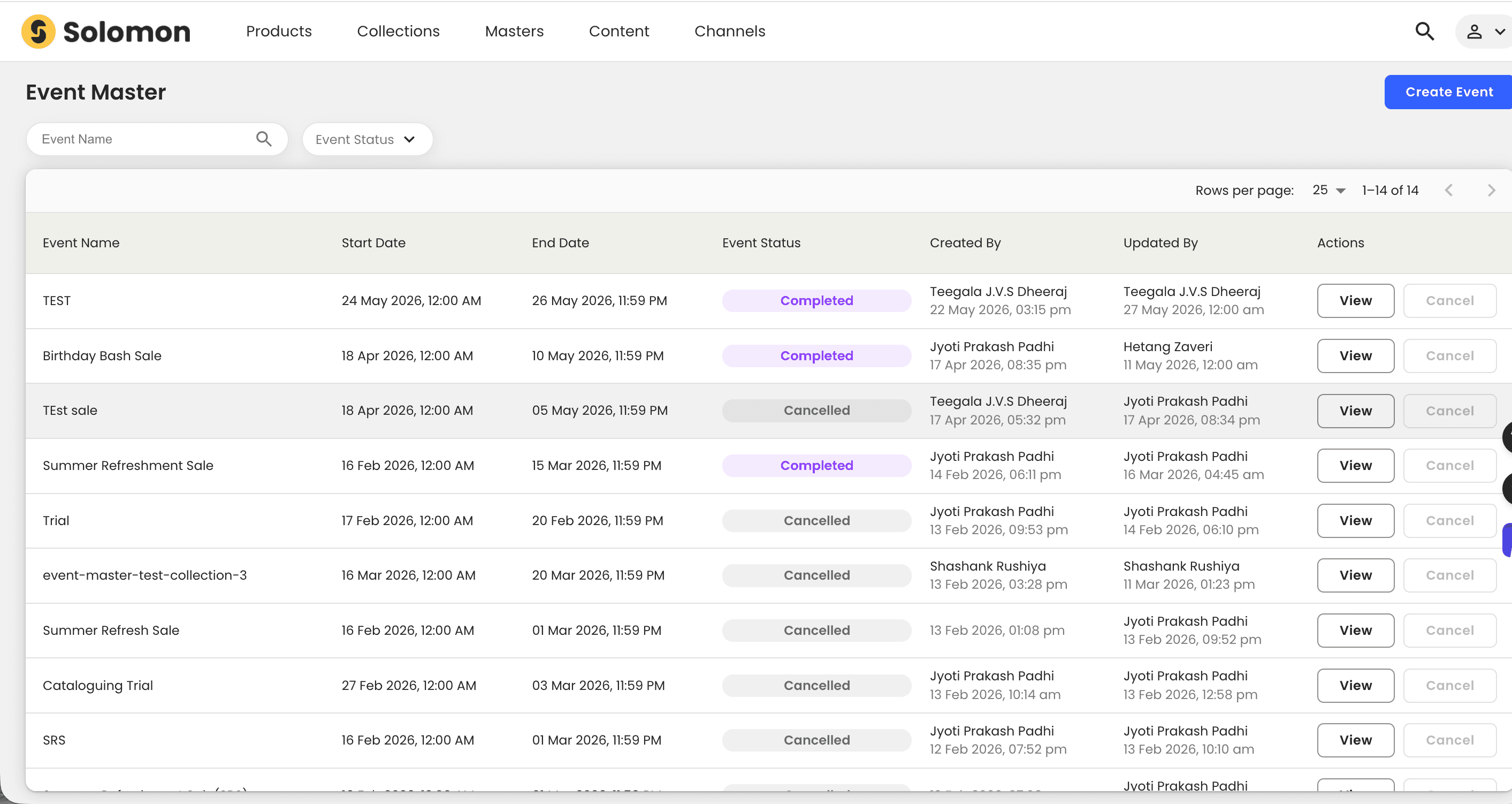
Event Master moved sale preparation from late-night manual uploads to a scheduled, validated, auditable workflow. It let category and catalog teams prepare campaigns weeks in advance, run validations early, fix errors before launch, and publish sales automatically at the scheduled time.
Problem Statement
Sale launches were delayed by manual uploads, repeated validation failures, late-night operations, and revenue-impacting campaign activation delays.
Existing Workflow
Teams waited until the sale day to upload pricing sheets. If validation errors appeared, catalog and operations teams had to fix them immediately under launch pressure, often delaying sale activation by 4-5 hours.
Business Context
Sale events are time-sensitive revenue moments. A delayed campaign means customers do not see intended pricing on time, business teams lose launch confidence, and operational teams spend energy on avoidable manual recovery.
Architecture
Designed as an event lifecycle platform with scheduled events, bulk price ingestion, pre-launch validation, retryable processing, audit logs, and automated publishing at the configured launch time.
Solution
Built Event Master so teams could create events weeks in advance, upload pricing immediately after vendor confirmation, run validations before launch, fix issues early, schedule the event, and let the platform publish validated pricing automatically.
Business Impact
Reduced sale launch time from 4-5 hours to under 30 minutes, removed repetitive manual operations, reduced launch failures, and improved customer experience during sales.
Pain Points
- Manual price-sheet uploads created repetitive operational work.
- Validation failures surfaced too late in the launch process.
- Campaign launches were delayed by 4-5 hours.
- Late-night uploads created avoidable operational stress.
- Delayed sale activation affected revenue and customer experience.
Responsibilities
- Designed the event lifecycle and scheduling model.
- Built validation and bulk-processing flows for sale pricing.
- Implemented automated publishing at scheduled launch time.
- Added retry mechanisms and audit logs for operational confidence.
- Worked with business workflows so teams could prepare campaigns well before launch.
Technical Implementation
- Created event entities with draft, validated, scheduled, publishing, published, and failed states.
- Built bulk upload and validation logic to catch pricing and data issues early.
- Implemented scheduling logic that consolidates validated pricing and publishes automatically.
- Added retry-safe processing so transient failures did not require full manual restart.
- Captured audit logs for uploads, validation failures, fixes, and publishing actions.
Technical Challenges
- Designing validations that surfaced launch-blocking issues early.
- Making scheduled publishing reliable for revenue-sensitive sale windows.
- Reducing manual intervention while preserving auditability and operational control.
Lessons Learned
- The highest-impact automation often moves validation earlier in the workflow.
- Scheduling systems need strong state models, retries, and audit trails.
- Operational confidence improves when business teams can prepare and verify work before launch pressure begins.
Tech Stack
- React
- Ruby on Rails
- PostgreSQL
- Background Jobs
- Scheduling
Launch delay reduced from 4-5 hours to under 30 minutesPre-launch validationAutomated sale publishing
Faster Product Go-Live
A Forge automation workflow that reduced catalog onboarding time from 30 days to 7 days.
Faster Product Go-Live
A Forge automation workflow that reduced catalog onboarding time from 30 days to 7 days.
Settlers
Automated vendor settlement platform for finance, reconciliation, invoices, GST reports, refunds, and payouts.
Settlers
Automated vendor settlement platform for finance, reconciliation, invoices, GST reports, refunds, and payouts.
Solomon
Centralized Product Information Management platform for catalog creation, master data, audit tracking, and Shopify sync.
Solomon
Centralized Product Information Management platform for catalog creation, master data, audit tracking, and Shopify sync.
Forge
Vendor portal providing self-service access to operational and finance data.
Forge
Vendor portal providing self-service access to operational and finance data.
Commerce Platform
Core service work across Vaaree's next-generation storefront and distributed commerce architecture.
Commerce Platform
Core service work across Vaaree's next-generation storefront and distributed commerce architecture.
Checkout
Checkout workflow ownership across pricing, promotions, payments, wallet, shipping, and order handoff.
Checkout
Checkout workflow ownership across pricing, promotions, payments, wallet, shipping, and order handoff.
Cart
Cart workflows for item state, pricing, promotions, availability, and checkout readiness.
Cart
Cart workflows for item state, pricing, promotions, availability, and checkout readiness.
Payment Orchestration
Payment flow coordination across payment options, callbacks, wallet, and order state.
Payment Orchestration
Payment flow coordination across payment options, callbacks, wallet, and order state.
Wallet
Wallet integration across checkout and payment workflows.
Wallet
Wallet integration across checkout and payment workflows.
Shipping
Shipping calculation and availability logic for storefront checkout flows.
Shipping
Shipping calculation and availability logic for storefront checkout flows.
Order Creation
Order creation workflows that connect cart, checkout, payments, wallet, promotions, and shipping.
Order Creation
Order creation workflows that connect cart, checkout, payments, wallet, promotions, and shipping.
Observability Improvements
Production visibility across logs, metrics, traces, errors, queues, and service behavior.
Observability Improvements
Production visibility across logs, metrics, traces, errors, queues, and service behavior.